Last Updated on February 24, 2026
Navigating the evolving landscape of California’s K-12 education requires a sharp focus on literacy and data-driven instruction. For school leaders and educators, the annual cycle of CA district CAASPP and ELPAC testing represents more than just a box to check; these assessments are critical benchmarks for student success. They serve as the primary indicators of how effectively we are equipping our students with the complex information-processing skills necessary for the modern world.
However, there is a hurdle in these exams that often goes overlooked in traditional test prep: listening comprehension.
While many literacy programs focus heavily on the “eyes-on-page” aspect of reading, the CAASPP and ELPAC require students to navigate “ears-on-audio” challenges. Whether it is a single-speaker informational lecture on the CAASPP or a nuanced multi-person classroom conversation on the ELPAC, success hinges on a student’s ability to filter, retain, and analyze spoken information in real-time.
Listenwise was built on the belief that listening is the “missing piece” of the literacy puzzle. Our team’s recent analysis of CA district CAASPP and ELPAC scores shows a significant correlation between the use of Listenwise and higher performance on state assessments.
In this deep dive, we’ll explore the recent data, the structural differences between CAASPP and ELPAC listening tasks, and how your district can leverage Listenwise’s authentic audio to move the needle on student achievement.
The Data: The Listenwise Advantage in California
For this analysis, we compared CA district CAASPP and ELPAC results from 2025 in districts that have at least one school using Listenwise against those that do not. The results were not just positive; they were statistically significant across multiple proficiency levels.
1. Lifting the Ceiling: More Students “Exceeding Standards”
One of the most striking findings in the data is the impact on high-achieving students. While many interventions focus solely on bringing students up to “nearly met,” Listenwise appears to provide the cognitive challenge necessary for students to reach the highest tier of performance.
- 17.51% Higher: The percentage of CAASPP test-takers who exceeded the standard is 17.51% higher in Listenwise districts compared to those without.
- 2.88% Higher: The percentage of students who met the standard is also 2.88% higher in these districts.
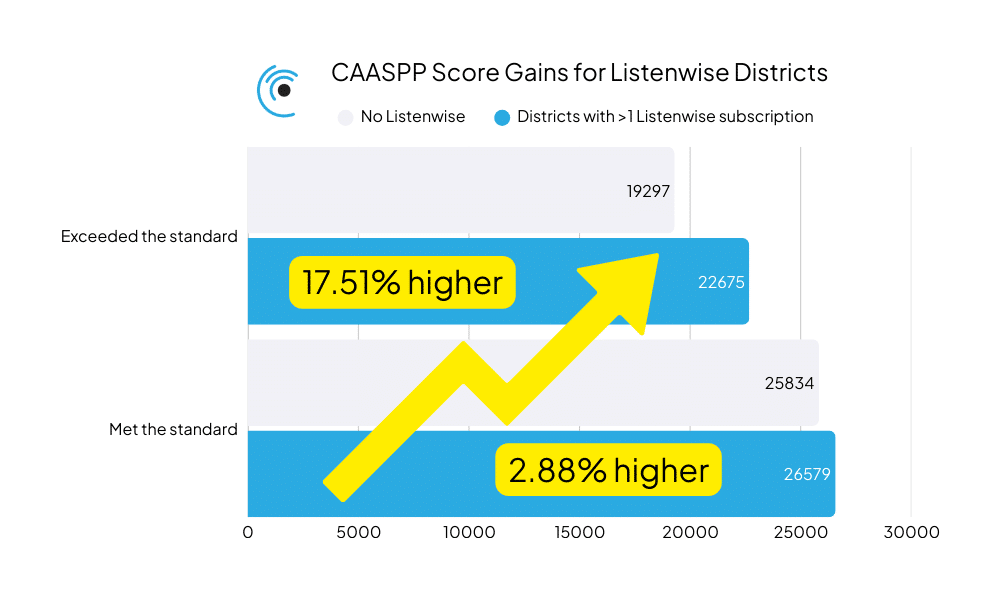
This suggests that by engaging with high-quality, complex, real-world stories and curated educational podcasts, students are developing the sophisticated vocabulary and critical thinking skills required to move from “proficient” to “advanced.”
2. Raising the Floor: Reducing “Below Standard” Scores
Listenwise is equally effective as a support tool for struggling learners. Because listening comprehension often precedes reading comprehension, audio serves as a powerful scaffold for students who may struggle with decoding but possess strong verbal reasoning skills.
- 8.71% Lower: The percentage of CAASPP test-takers who did not meet the standard is 8.71% lower in Listenwise districts.
- 5.88% Lower: The percentage of test-takers who nearly met the standard is also 5.88% lower.
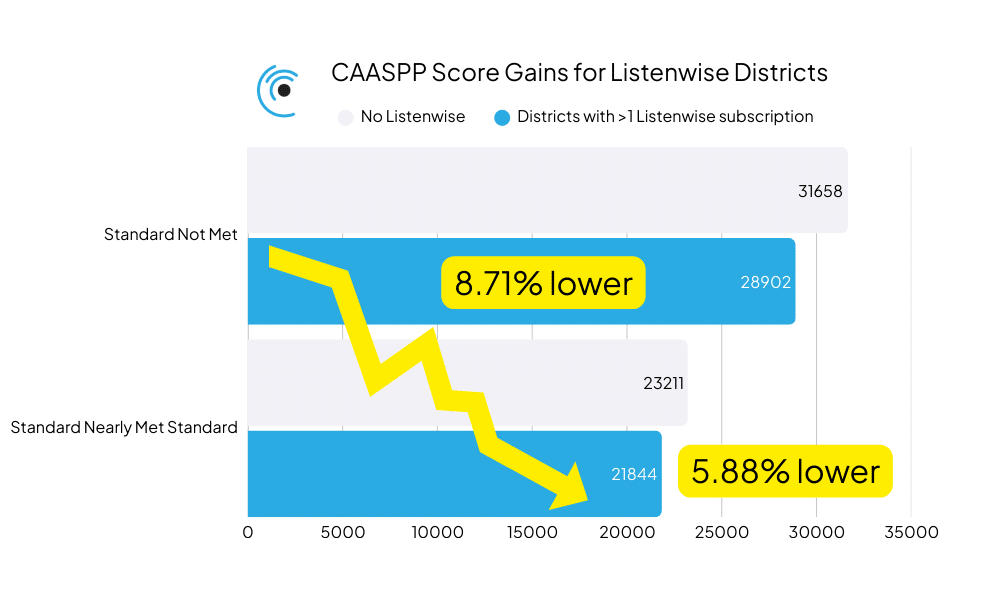
In other words, by providing an alternative entry point to complex grade-level content, Listenwise helps prevent students from falling behind, ensuring a higher “floor” for district-wide performance.
3. Mastering the Listening Claim
The CAASPP ELA exam is broken down into various “claims,” including Reading, Writing, and Listening. When we zoomed in on the specific Listening data, the impact of regular practice was undeniable:
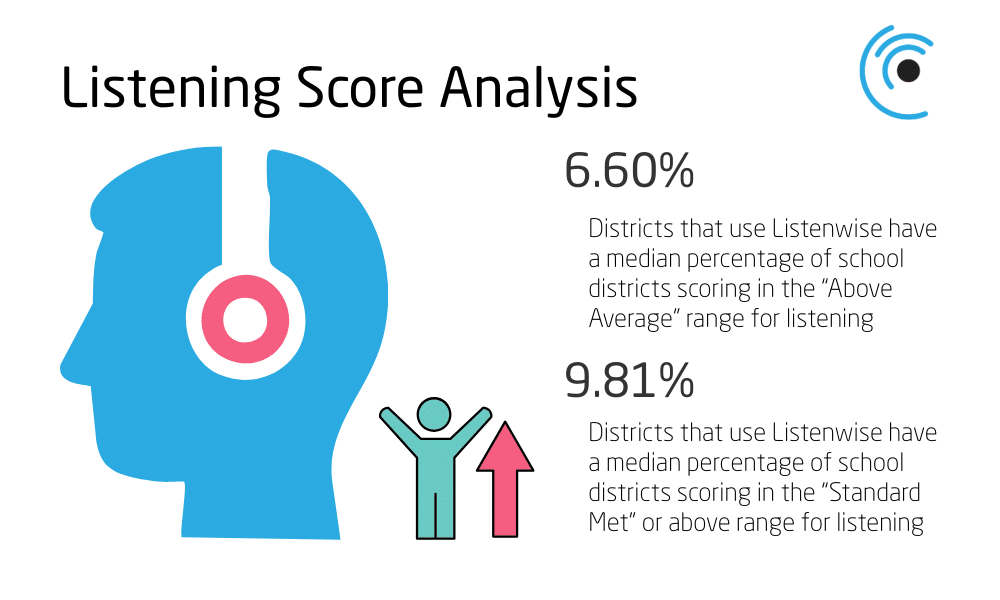
- 6.60% Higher: The median percentage of school districts in the “Above Average” range for Listening is 6.60% higher in Listenwise districts.
- 9.81% Higher: A significantly higher share of test-takers is “Above Standard” in the listening portion specifically.
4. Supporting English Learners: ELPAC Gains
For English Learners, the ELPAC is a critical gateway to reclassification (RFEP status). The ELPAC places a heavy emphasis on oral language and listening in social and academic settings.
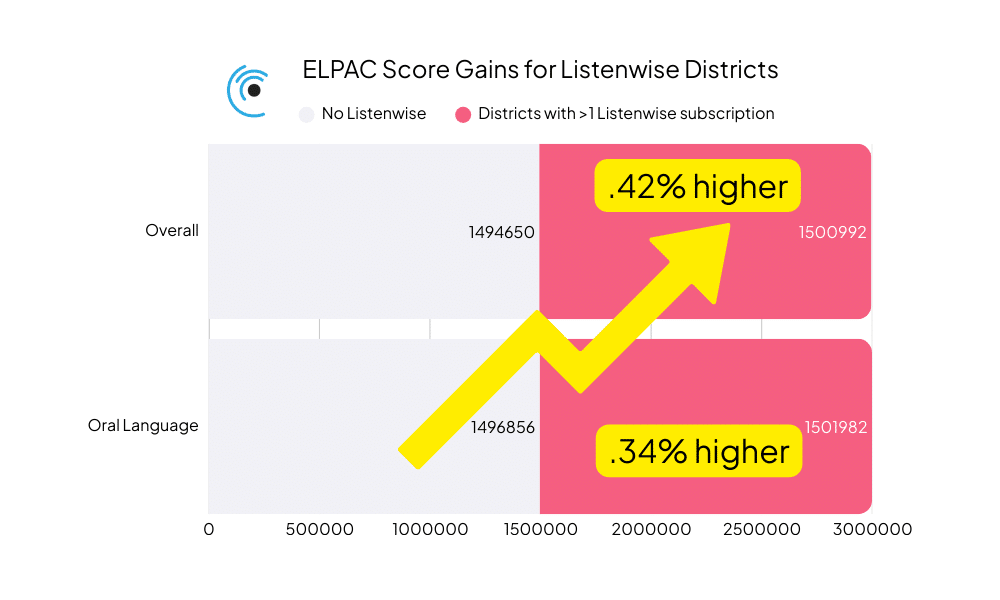
- 0.42% Higher Overall: ELPAC overall scores are, on average, 0.42% higher in Listenwise districts.
- 0.34% Higher in Oral Language: Because Listenwise features authentic human voices—not AI text-to-speech—students develop a better ear for the cadence, tone, and nuances of English, leading to higher Oral Language scores.
Understanding the Listening Challenge
To understand why Listenwise works, we must first understand the unique demands of the California assessments. Many educators treat CAASPP and ELPAC prep as a monolithic task, but the listening requirements for each are distinct.
The CAASPP Listening Format
The CAASPP ELA assessment generally presents informational or narrative audio. Typically, these are short informational texts read aloud by a single speaker. The content is usually tied to common grade-level curriculum topics (e.g., a passage on space exploration for 5th graders).
- Student Experience: On the CAASPP, students listen individually through headphones. They have the ability to pause and replay the audio, and they are encouraged to use the digital notepad tool within the testing interface to take notes.
- The Skill Needed: The primary skill here is sustained focus and note-taking. Students must be able to identify the main idea and supporting details from a lecture-style monologue.
The ELPAC Listening Format
The ELPAC is fundamentally different. It is designed to measure how well an English Learner can navigate the “language of school.” This means the audio is often more conversational and interactive.
- Student Experience: Unlike the CAASPP, the ELPAC listening segments are often played only once for a group of students. There are four types of listening segments, ranging from short “listen and choose an image” tasks to longer “classroom conversations” and “oral presentations.”
- The Skill Needed: Students must be able to distinguish between two different speakers (e.g., a teacher and a student, or two peers). They need to understand speaker intent, point of view, and the flow of a natural conversation.
3 Ways That Listenwise Bridges the CA District CAASPP and ELPAC Gap
Listenwise was designed to address these exact challenges. We don’t just provide audio; we provide a structured instructional platform that mirrors the rigors of state testing while keeping students engaged with real-world stories. Here are three things Listenwise can do to support teachers’ efforts to improve their CA district CAASPP and ELPAC scores.
1. Mirroring the Test Environment
Preparing for a test isn’t just about content; it’s about the format. If a student only ever practices by reading text, the first time they encounter a 3-minute audio passage on a test, they may struggle with cognitive load.
Listenwise allows teachers to mimic the testing environment:
- Single vs. Multi-Speaker: Our library includes both solo narrations (great for CAASPP prep) and interviews/dialogues (perfect for ELPAC prep).
- Controlled Playback: Teachers can instruct students to listen only once to simulate the ELPAC, or allow replays to practice the note-taking strategies required for the CAASPP.
- Interactive Transcripts: For EL students, the transcript is a vital scaffold. However, as testing nears, teachers can hide the transcript to ensure students are relying solely on their ears—just as they will on the day of the exam.
2. Building Academic Vocabulary
One reason Listenwise districts see higher overall ELA scores is the focus on academic language. Our stories cover science, social studies, and current events. When a 7th grader listens to a story about the Roman Empire or the biology of a virus, they are hearing high-level vocabulary words used in context.
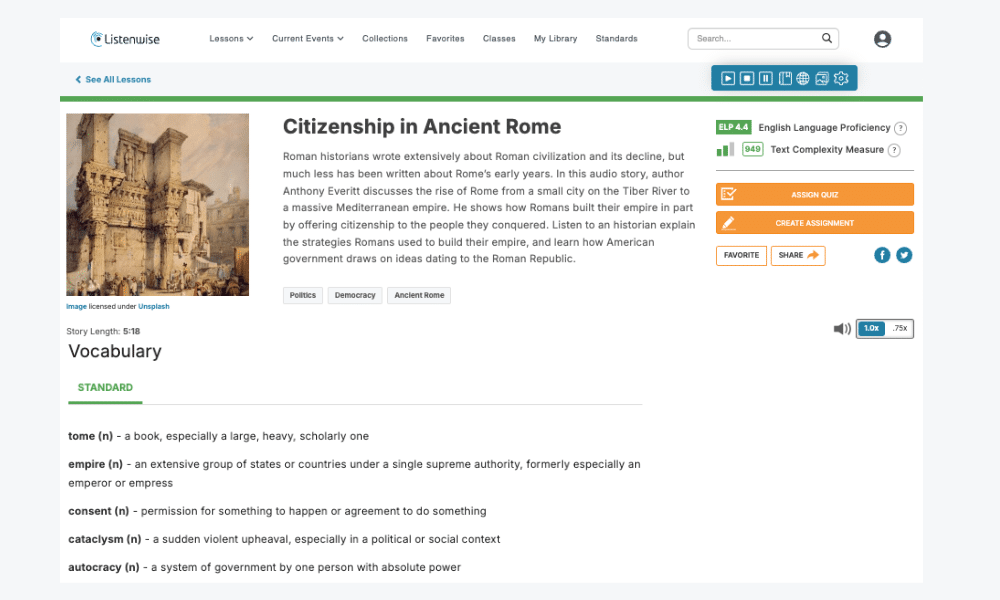
Research shows that we have a “listening vocabulary” that is often more advanced than our “reading vocabulary.” By hearing a word like resilient or infrastructure in a compelling story, a student is more likely to recognize and understand that word when it later appears in a CAASPP reading passage.
3. Integrated Formative Assessment
Every Listenwise lesson comes with a Listening Comprehension Quiz. These are not just “memory checks.” They are aligned with Smarter Balanced (SBAC) and CAASPP standards, focusing on:
- Main Idea/Evidence
- Vocabulary in Context
- Inference
- Literal Meaning
By taking these quizzes weekly, students become “test-wise.” They learn what types of information to listen for, reducing the anxiety that often accompanies the “Listening” portion of the state exam.
A Strategy for District Leaders
If you are a curriculum director or an administrator looking to improve your district’s performance, the implementation of a listening-first strategy is a high-leverage, low-friction move. Here are some methods of Listenwise implementation that administrators and district leaders have found support CA district CAASPP and ELPAC gains.
Step 1: Audit Your Current Literacy Block
Look at your current ELA and ELD curriculum. How much of it is dedicated to active listening? Often, “listening” in a classroom is passive—students listening to a teacher give instructions. Active listening—where students must process audio and answer high-level questions—is often missing.
Step 2: Implement “Listening Fridays” or “Daily Listen”
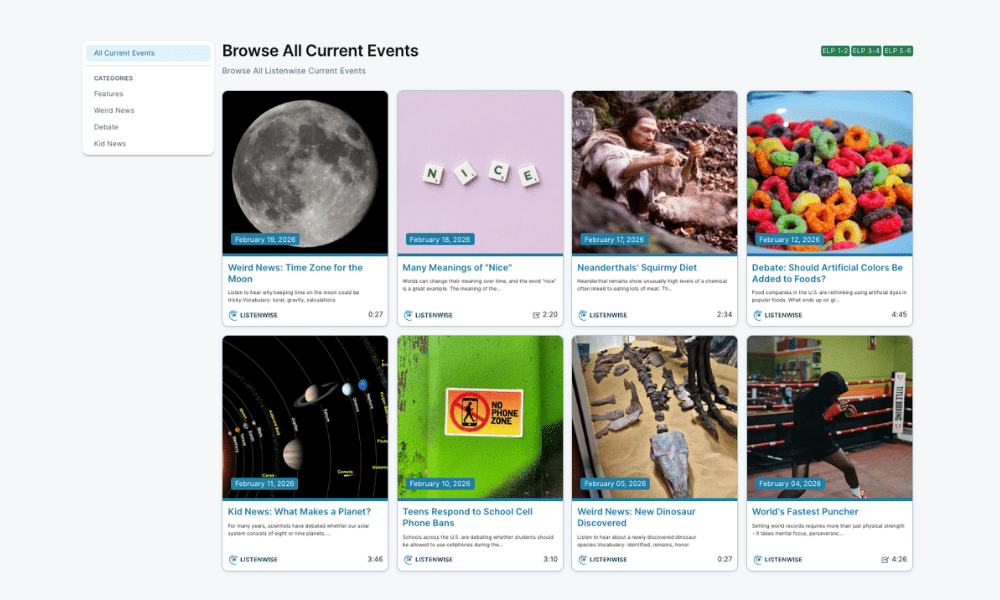
Districts that see the most success with Listenwise don’t use it as a “once-in-a-while” treat. They integrate it. A 5-minute “Current Events” listen at the start of class, followed by a quick discussion, builds the “listening muscle” over time.
Step 3: Targeted ELD Support
Use the Listenwise ELD Lesson Library specifically for your English Learners. These lessons are designed with slower speech rates, built-in picture dictionaries, and “speaker opinion” tasks that directly align with the ELPAC.
Step 4: Use Data to Drive Instruction
Listenwise provides a teacher dashboard that tracks student progress on specific listening skills. If a teacher sees that a whole class is struggling with inference, they can pivot their instruction to focus on that specific skill before testing season arrives.
The Human Element: Engaging Students with Stories
Beyond the data and the test scores, there is a simpler reason why Listenwise works: Students love it.
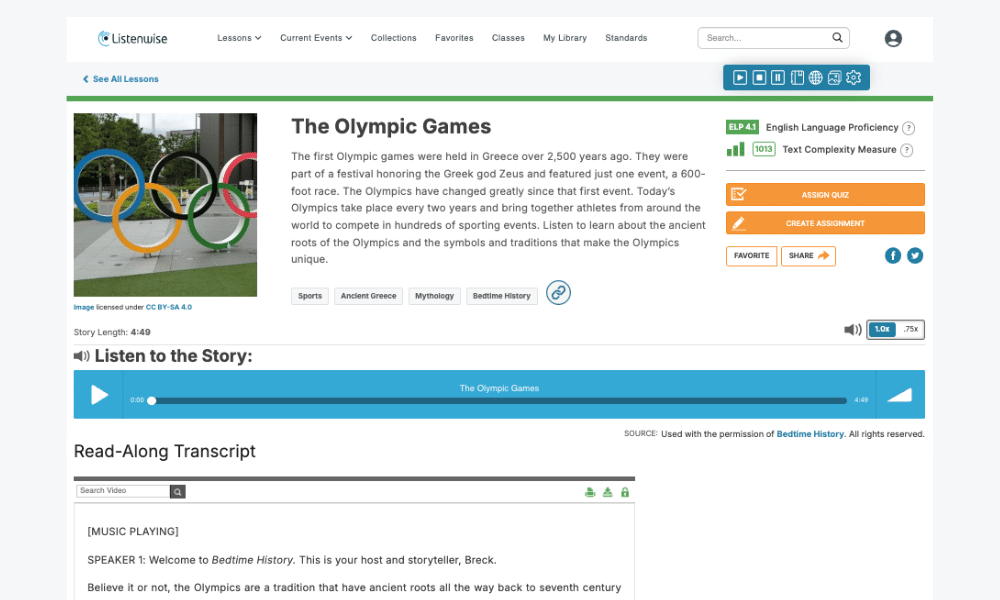
The CAASPP and ELPAC can feel clinical and detached from a student’s daily life. Listenwise brings the world into the classroom. Whether it’s a story about a teenager navigating the world with a cochlear implant, the history of the Olympic games, or the mystery of disappearing bird populations, these are stories that matter.
When students are engaged with the content, they listen more closely. When they listen more closely, they learn. And when they learn, the test scores take care of themselves.
